Introduction
Set basics
Relationships between sets
Instruction
Fantastic! We can use union() in a similar way:
kate_fav_movies = {'Halloween', 'A Star Is Born', 'Hocus Pocus'}
alan_fav_movies = {'A Star Is Born', 'The Lion King', 'Harry Potter'}
common_fav_movies = kate_fav_movies.union(alan_fav_movies)
print('Together, Alan and Kate like the following movies:', common_fav_movies)
The union() function creates a set that contains elements from both sets, as shown in the diagram:
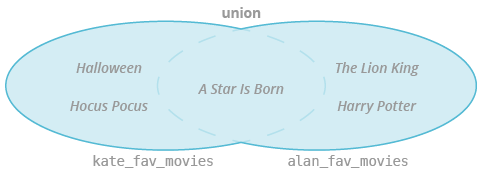
You can also use this abbreviated notation:
kate_fav_movies | alan_fav_movies
Exercise
XYC Corp. has some employees in cities A and B, as shown in the template code. Some of the employees work in both cities.
Your task is to create a union set from cities A and B and print the following sentence:
There are {x} employees in cities A and B.
Instead of {x}, provide the total number of unique employees in both cities.
Note: you can use len(set) to get the number of elements in a set.
Stuck? Here's a hint!
Use:
len(city_a_employees.union(city_b_employees))