Introduction
Total revenue for multiple periods
Calculating deltas
Creating "revenue in quarters" reports
Instruction
Very well done! In the previous explanation, we calculated the quarterly revenue in each year. Now, let's say we want a report containing:
- quarterly revenue values.
- annual revenue values.
- the grand total revenue value.
Here's an example of the result we'd like to achieve:
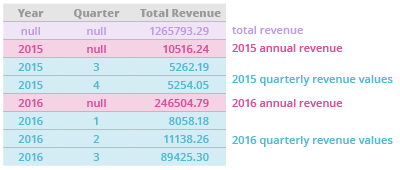
Sound complicated? Here's a query to handle it:
SELECT
  DATEPART(Year, OrderDate) AS RevenueYear,
  DATEPART(Quarter, OrderDate) AS RevenueQuarter,
  SUM(Amount) AS TotalRevenue
FROM Orders
GROUP BY ROLLUP(
  DATEPART(Year, OrderDate),
  DATEPART(Quarter, OrderDate)
)
ORDER BY
  DATEPART(Year, OrderDate),
  DATEPART(Quarter, OrderDate);
We introduced a small change in the GROUP BY clause. Instead of:
GROUP BY
  DATEPART(Year, OrderDate),
  DATEPART(Quarter, OrderDate)
we used:
GROUP BY ROLLUP(
  DATEPART(Year, OrderDate),
  DATEPART(Quarter, OrderDate)
)
Let's run the query and see what happens.
Exercise
Run the template query.
As you can see, we've got rows showing three aggregation levels: the grand total revenue, annual revenues, and the quarterly revenues for each year.
In other words, now you can see:
- the grand total revenue – the total sum for all years (
RevenueYearandRevenueQuarterbeingNULL). - the annual revenues – the sums for each year (
RevenueQuarterbeingNULL). - the sums for each year and quarter (being the results of the query from the pevious exercise).
Stuck? Here's a hint!